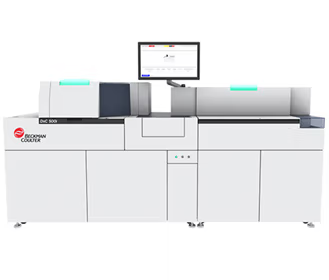
DxC 500i

Chemistry Analyzer

Where Flexibility Drives Productivity
Meet your partner for integrated testing with a simplified workflow. The space-saving DxC 500i Clinical Analyzer delivers high-quality chemistry and immunoassay results you can trust for your low-volume lab.

Count on the Beckman Coulter Tradition of Reliability

We’ve designed reliability into every corner of the DxC 500i so you can count on:

  • Exceptional uptime
  • Consistently accurate results
  • A broad portfolio including high-performing immunoassay and chemistry menus
  • A solid supply chain that keeps you prepared to run the tests you need
  • Dependable service
Enjoy a Consistent User Experience—And Consistently High Quality

We designed the analyzer to provide the simple operation and superior clinical quality you have come to expect from us. Standardized features include:

  • Many shared reagents and consumables with legacy Beckman Coulter analyzers for commutable patient results and simplified inventory management
  • Familiar look and feel to minimize training
  • DxLAB sample rack for streamlined sample handling
Meet the SimpleSolve Onboard Guide


Partnering with you every step of the way, the SimpleSolve onboard guide notifies you of problems and helps you fix them before they derail progress—minimizing downtime and putting control back in your hands.

Deliver Critical Results at the Speed of Patient Care

The DxC 500i offers rapid time to first results—in as few as eight minutes for chemistry tests and 18 minutes for immunoassay panels like βhCG. Coupled with random access to expedite priority samples, this analyzer can support even the busiest shifts.

Furthermore, we help you handle testing surges with rapid throughput—up to 100 immunoassay tests per hour and 400 photometric chemistry tests per hour (up to 800 with ISEs).

Optimize Your Workflow

In today’s busy labs, every minute counts. We’ve optimized every part of the DxC 500i to maximize your efficiency so you can focus on your top priorities.

  • Load chemistry and immunoassay reagents and consumables on the fly
  • Reduce hands-on time with one point of entry for chemistry and immunoassay samples
  • Streamline sample handling and deliver critical results faster with a 12-lane sample handler
One-Tube Chemistry and Immunoassay Testing

You don’t need multiple tubes to run multiple tests. With the DxC 500i, load just one tube for both chemistry and immunoassay testing. That means fewer pour-offs, less time handling samples, more walk-away time, and simpler workflows for everyone.

Main Specifications

Analytical method

Fully automated, random-access integrated system with clinical chemistry and immunoassay modules

Analytical principles

Spectrophotometry, potentiometry, and chemiluminescence

Assay types

  • Chemistry: Endpoint, rate, fixed point, indirect ISE
  • Immunoassay: Competitive assay, Sandwich assay, and Antibody detection assay

Analytical method

  • Chemistry: Colorimetry, turbidimetry, latex agglutination, and indirect ISE
  • Immunoassay: Paramagnetic coated antibody/antigen

Chemistry menu capacity

>170 preprogrammed assays currently available

Throughput

  • 400 photometric tests per hour, up to 800 with ISE
  • 100 immunoassay tests per hour (one-step assays)
  • ISE maximum test per hour: 600 if ISE only
  • HbA1c maximum tests per hour: 65 if HbA1c only

Sample types (assay dependent)

Serum, plasma, urine, CSF, whole blood, and amniotic fluid

Sample management/capacity

  • 168 sample tubes (24 racks of 7 tubes), unique continuous loading feature
  • Independent analysis:
    • Chemistry: 22 samples in refrigerated STAT carousel
    • Immunoassay: 60 samples in 6 carousel racks

Barcoded reagents

Automatic tracking of: available tests, expiration date, lot number

Sample container sizes

  • Sample tubes:
    • 13 x 75 mm, 13 x 100 mm, 16 x 100 mm
    • Sarstedt S-Monovette 4.9 mL, 5.5 mL, 7.5 mL
  • Cups/insert cups:
    • 0.5 mL, 2.5 mL, 3.0 mL cups
    • 1.0 mL, 2.0 mL insert cups, pediatric insert
    • Auto aliquot

Sample volume (assay dependent)

  • Chemistry: 1.0 –25 μL in 0.1 μL increments (assay dependent)
  • Immunoassay: 10–110 μL

Sample barcode symbology

Codabar (NW-7), CODE 39, CODE 128, ISBT-128, Interleaved 2 of 5

Compartment temperatures

  • Chemistry:
    • Chemistry reagent compartment: 39.2°F to 53.6°F (4°C to 12°C)
    • STAT wheel: 39.2°F to 53.6°F (4°C to 12°C)
    • Cuvette wheel: 98.6°F ± 0.5°F (37°C ± 0.3°C)
  • Immunoassay:
    • Reagent compartment: 33°F to 41°F (1°C to 5°C)
    • Maintains air and reagent temperature at 37.4°F to 50°F (3°C to 10°C)
    • Incubator and wash/read wheel: 97.5°F ± 0.5°F (36.4°C ± 0.3°C)

Reagent storage capacity

  • Chemistry: 76 positions in a refrigerated reagent carousel that holds 15 mL, 30 mL, and 60 mL bottle sizes
  • Immunoassay: 24 positions in refrigerated reagent carousel

Reaction cuvette

  • Chemistry: Permanent glass cuvettes
  • Immunoassay: Disposable reaction vessels

Sample quality analysis

  • Lipemia, hemolysis, and icterus indices
  • Clot detection and probe crash protection

Calibration (assay dependent)

  • Chemistry: calibration curve stability up to 90 days
  • Immunoassay: calibration stability up to 63 days
  • Calibration curves and parameters displayed on screen
  • Calibrator setpoint entry through barcode scan

Quality control

  • Shewhart day-to-day management (Levey-Jennings method)
  • Multi-rule control (Westgard method)

Installation Requirements

Dimensions and weight

  • Analyzer with monitor:
    • Weight: Dry, 1,430 pounds (<650 kg)
    • Length: 100 in (254 cm)
    • Height: 48.8 in (124 cm)
    • Height with monitor: 63.0 in (160 cm)
    • Depth: 30.3 in (77 cm)

Clearance Requirements

  • Clearance around the analyzer for ventilation:
    • Rear: minimum of 24 in (64 cm)
    • Left: minimum of 20 in (50 cm)
    • Right: minimum of 20 in (50 cm)
    • Front: minimum of 25 in (63.5 cm)>
    • Top (from the top of the chemistry analyzer): Minimum of 49 in (124 cm)

Waste requirements

  • Chemistry module drain location:
    • Maximum distance: 33 ft (10 m) from the system
    • Maximum height: 5 ft (1.5 m) from the floor
  • Chemistry module drain volume:
    • Concentrated waste: 5.5 L/hour (normal), 7.5 L/hour HbA1c
    • Diluted waste: 12 L/hour
  • Immunoassay module drain location:
    • Maximum distance 9.8 ft (3 m) from the system
    • Maximum height 3 ft (0.9 m) from the floor
  • Immunoassay module drain volume:
    • 1 L/hour
  • Immunoassay module solid waste: (RVs):
    • RVs collected in RV waste bag (300 RV capacity)

Water supply requirements

  • Maximum water consumption: 20 L/hour
  • Water type: Deionized CAP type II or better, bacteria free
  • Continuous flow supply
  • Resistivity: > 0.5 MΩ∙cm filtered with a 0.5 μm filter

Power and environmental requirements

Power supply: 200V, 208V, 220V, 230V, 240V, 50/60Hz, 3.5kVA

Computer

  • Storage: 960GB SSD
  • Operating system: Windows 10
  • External communication types: RS232 serial interface
  • Ethernet: LAN using TCP/IP

Monitor

  • Touchscreen display: 21.5 in (54.6 cm) diagonal TFT LCD with projected capacitive touch
  • Pixels: 1920 x 1080 RGB

Operating environment

  • Ambient temperature: 64°F to 82°F (18°C to 28°C)
  • Humidity: 20% to 80% RH (without condensation)
  • Altitude: Maximum 2,000 m (6,561 ft) above sea level
  • Noise level: <75 dBA

Communication modes

Serial or TCP (1 or 2 physical) connection to LIS per ASTM protocol
WhatsApp Chat